


Driven by experience
Exporter of Rubber Products worldwide


Interlocking Tiles vs. Rolled Rubber flooring is a common comparison for anyone planning a home or commercial gym. Both options are made from rubber flooring, which protects yur floor from damage and helps absorb impact. The best choice depends on your gym size, budget, and whether you want the flexibility to change your layout later.
In this blog, we will compare interlocking tiles and rolled rubber flooring. Including their installation, durability, cost, and the best uses for each. This will help you to choose the right gym flooring for your space.
Understanding Interlocking Tiles and Rolled Rubber Flooring
Before comparing interlocking rubber tiles and rolled rubber flooring, it’s important to understand what each option is and where it works best. This will help you to choose the right gym flooring according to your requirements.
Interlocking Rubber Tiles: The DIY and Versatile Champion
Interlocking rubber tiles are pre-cut gym flooring tiles with puzzle-shaped edges that fit together without glue. They are a popular choice for home gyms, small workout spaces, and areas where you may want to change or move the flooring later. The biggest advantage of interlocking tiles is their easy DIY installation. These gym flooring types are lightweight, simple to handle, require only a utility knife for cutting edge pieces, and usually do not need adhesive. This makes them a cost-effective and convenient flooring option.
Moreover, if you are looking for more tile options, then you can see the best Rubber Floor Mats for the Gym.
Key Benefits of Interlocking Rubber Tiles:
- It is an easy DIY installation with no adhesive needed.
- This flooring option is portable and non-permanent, which makes it easy to remove and reinstall.
- Also, damaged tiles can be replaced individually, which saves on replacement costs.
- These interlocking tiles are available in different colours and patterns to create separate training zones.
- In addition, it is best for home gyms, small to medium, irregularly shaped rooms, gyms in the basement, or temporary fitness areas.
Cost and Installation Factors
Rolled Rubber Flooring: The Commercial and Seamless Powerhouse
Rolled rubber flooring comes in large sheets, usually 4 feet wide and is available in long lengths to cover large areas with fewer joints. Once installed with adhesive, this gym flooring creates a strong, seamless, and permanent gym floor.
The biggest benefit of rolled rubber flooring is its smooth, low-seam surface. With fewer gaps, it is easier to clean, helps to reduce the buildup of dust, sweat, and bacteria, and this rolled rubber flooring is ideal for commercial gyms, weightlifting areas, and fitness studios. In addition, it also stays firmly in place under heavy gym equipment and in busy workout areas.
Key Benefits of Rolled Rubber Flooring
- This flooring never-seamess surface for easy cleaning and maintenance.
- It is strong and stable under heavy gym equipment.
- Rolled rubber gym flooring provides excellent shock absorption and noise reduction,, especially in the thicker rolls.
- More cost-effective for covering large gym areas.
- In addition, it is best for home gyms, small to medium, irregularly shaped rooms, gyms in the basement, or temporary fitness areas.
Cost and Installation Factors
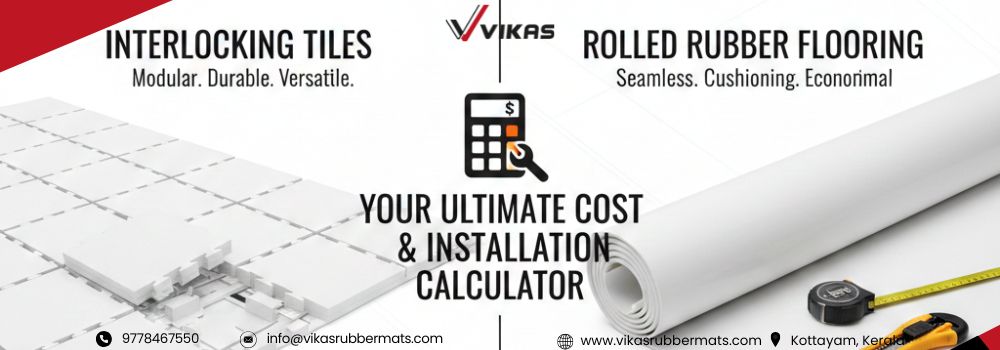
The Ultimate Cost and Installation Calculator: Tiles Vs Rolls
Your final decision should be driven by a simple formula: Space Size + Use Case = Best Flooring Choice.
Project Size and Total Cost
In the case of small projects (less than 300 square feet), interlocking rubber tiles are usually the most affordable option. Their easy do-it-yourself installation incurs a slightly higher material cost per square foot, but this is significantly offset, making them great for a garage gym. Rolled rubber is usually not recommended here, as cutting and the heavier rolls lead to waste and difficulty. For medium projects (300 - 800 sq. ft.), the choice is a tie.
While rolls offer a lower material cost per square foot, the tiles' simple DIY nature can save substantially on labour, depending on your installation skill versus your budget for professional help. Finally, for large projects (1,000+ sq. ft.), rolled rubber flooring is the clear winner. The low bulk material cost, combined with faster professional installation, results in the lowest overall cost per square foot. Tiles are generally not recommended for large areas as installation becomes extremely time-consuming and the increased number of seams can become a visual and hygiene issue.
The Installation Difficulty Score
Interlocking Tiles, without a doubt, are the king in terms of convenience when it comes to installation (DIY Score: 5/5). These tiles are so light that one person easily handles them. Besides, one needs just a utility knife to cut the edges. They are usually laid down like loose flooring, which means that no glue is used.
On the other hand, Rolled Rubber Flooring is a lot more difficult (DIY Score: 2/5). The rolls are extremely heavy and big, so very often they have to be moved by two or more people. Cutting with utmost care and skill is necessary to get the tight seams and straight edges; each time a very sharp utility knife and straight edge should be used. For a permanent and high-performance floor, glue-down installation using a special adhesive is always recommended. Importantly, while both types need a clean subfloor, the seamless quality of the rolls means that every bump or dip in the subfloor will be "telegraphed" through the rubber, thus requiring super-critical and flawless subfloor preparation.
Application and Longevity
In the case of Heavy Weightlifting, along with the impact zones, Rubber Flooring, available in rolls, is the first choice. Glue-down gives it such stability that it will not shift under heavy equipment, and in thicker gauges, it will give you the maximum shock absorption and will protect the subfloor the most. You can use tiles, but thicker tiles (1/2" or more) should be your choice, and there are good points about their being replaceable in case of damaged spots.
For areas like Cardio/Yoga or general fitness, both are great options, but thinner tiles (8mm or 3/8") can sometimes be the more economical choice. Regarding Hygiene and Wet Areas, Rolled Rubber Flooring installed seamlessly and glued down offers higher resistance to water and less opportunity for dirt, bacteria, and moisture to accumulate due to the reduced crevices, so it is the more preferred option over tiles that have exposed seams, which can let moisture through to the subfloor.
Read More: How to Choose the Right Rubber Mat Thickness for Your Application
Final Verdict: Which Rubber Flooring is Right for You?
The perfect rubber floor covering is the one that fits in with your financial plan, skill level, and layout of the house.
Select Interlocking Rubber Tiles in cases where:
- Setting up a home gym that does not exceed 500 sq. ft.
- Want a simple DIY installation and also want to cut down on labour costs.
- Looking for a flooring for your gym that you can easily take with you.
- Want to replace specific areas of the floor gradually.
Select Rolled Rubber Flooring in cases where:
- Supplying a commercial gym, fitness studio, or a big area of more than 800 sq. ft.
- Looking for a seamless look and having hygiene as the major concern in the long run.
- Requiring the highest level of shock absorption and supreme protection for your subfloor from the impact of Olympic lifting and heavy machinery.
- Ready for the professional installation costs for a permanent flooring that is high performance.
Need Help in Choosing the Right Gym Flooring?
If you are not sure which gym flooring is best for your space? Tell us your gym size, workout type, and whether you need a permanent or flexible flooring solution. Our team will help you to choose the right rubber flooring format and thickness for your needs. Contact us today, and explore our complete Gym flooring range today.
Call/WhatsApp: +91 96450 05044
Email: info@vikasrubbermats.com

Certification


